
What is an ETF, and how does it work?
An ETF, or exchange-traded fund, is a basket of investments that you can buy and sell as a single share. This guide covers how ETFs work, how they differ from individual stocks and mutual funds, what an expense ratio is, and the main risks. No experience required.
01 The basics
What is an ETF?
An ETF is a fund that holds a collection of assets, such as dozens or hundreds of stocks, and trades on an exchange like a single stock. When you buy one share of an ETF, you get a small slice of everything inside it.
Think of it as a ready-made basket. Instead of buying shares in fifty companies one by one, you buy one ETF share and own a tiny piece of all fifty at once. That is called diversification, and it is the main reason ETFs are popular with new investors.
ETFs can hold more than just stocks. Some hold bonds, some hold gold or other commodities, and some now hold crypto. Whatever is inside, the ETF share tracks the combined value of those holdings and moves up and down with them.
Diversification
Owning many assets at once so a single bad performer has less impact on you.
Index
A list that tracks a group of assets, like the 500 largest US companies, which many ETFs are built to follow.
Share
A single unit of the ETF that you buy and sell, priced throughout the trading day.
02 How it works
ETF vs stock vs mutual fund
The easiest way to understand an ETF is to compare it to the two things people confuse it with.
A stock is a share in one company. If that company does well, your share rises; if it struggles, your share falls. All your risk sits with that single business. An ETF spreads your money across many companies, so one failure hurts less. The trade-off is that a single winning stock can rise far more than a diversified basket.
A mutual fund is also a basket of assets, so people mix the two up. The key differences: an ETF trades throughout the day at a live price, while a mutual fund is priced only once, after the market closes. ETFs usually cost less to own, and most ETF money still sits in funds that simply track an index rather than being actively managed by a person picking investments.
03 What you can trade
Types of ETFs and their costs
ETFs come in several flavours, and the type tells you what is inside.
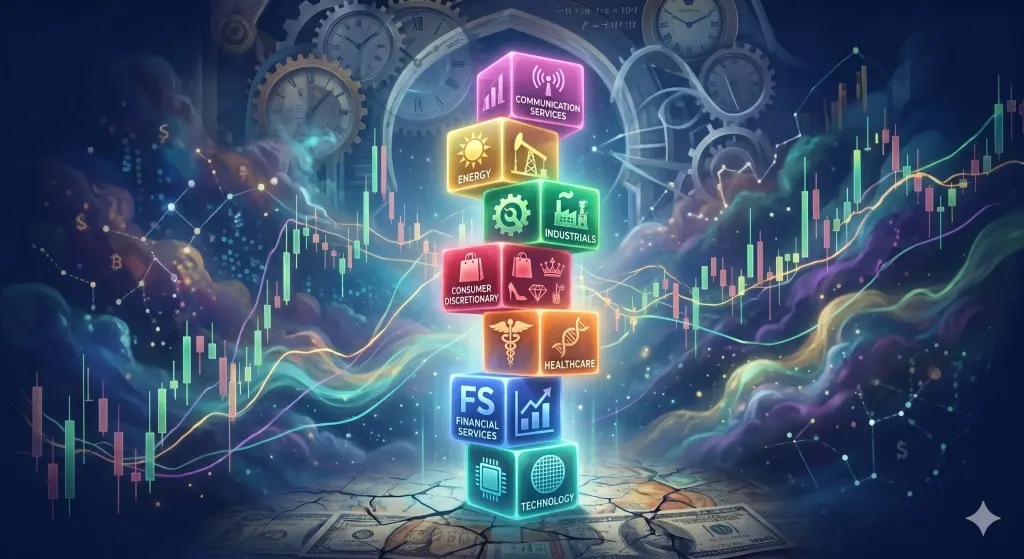
Index ETFs track a broad market, such as the largest companies in a country. Sector ETFs focus on one area like technology or healthcare. Bond ETFs hold government or company debt. Commodity ETFs track things like gold. Thematic ETFs follow a trend such as clean energy or artificial intelligence. Crypto ETFs hold or track cryptocurrencies, giving stock-style exposure to assets like Bitcoin.
Every ETF charges an annual fee called the expense ratio, shown as a percentage. A low-cost index ETF might charge around 0.03% to 0.20% a year, while a specialised or actively managed one can charge 0.50% or more. It sounds tiny, but on money held for many years, a higher expense ratio quietly eats into your returns.
Pick a theme
Decide what you want exposure to, such as a broad index, a sector, or crypto.
Check the holdings
Look at what the ETF actually owns, since two similar-sounding ETFs can differ.
Compare the expense ratio
A lower annual fee means more of the return stays with you.
Check the size
Larger, well-traded ETFs are usually easier to buy and sell at a fair price.
04 Get started
Buying your first ETF
Buying an ETF works the same way as buying a stock. You open an account with a broker or investing app, add funds, search for the ETF, and place an order. Many platforms let you buy a fractional share, so you can start with a small amount rather than the full price of one share.
Before you buy, do two quick checks. Read what the ETF holds so you know what you are actually getting, and look at the expense ratio so you know the annual cost. Those two numbers tell you most of what matters.
If the ETF pays dividends, which are cash payments passed on from the companies it holds, you will usually receive them as cash or have the option to reinvest them automatically. Not every ETF pays dividends, so check if that matters to you.
Related articles

FAQ
What is the difference between an ETF and a stock?
A stock is a share in one company. An ETF is a basket of many assets bought as a single share. The ETF spreads your money across many holdings, so one company doing badly has less impact than it would if you owned only that stock.
Are ETFs safe for beginners?
ETFs are widely used by beginners because diversification lowers single-company risk. They are not risk-free, though. An ETF still rises and falls with the market, and you can lose money. ETFs are not bank deposits and carry no such guarantee.
What is an expense ratio?
The expense ratio is the annual fee an ETF charges, shown as a percentage of what you have invested. A broad index ETF might charge around 0.03% to 0.20% a year. Over long periods, a lower expense ratio leaves more of the return with you.
Do ETFs pay dividends?
Some do. If the companies inside an ETF pay dividends, the ETF usually passes that cash on to you, either as a payment or an option to reinvest automatically. Not every ETF pays dividends, so check the specific fund.
Products and features listed may be subject to change and are not a commitment to deliver any material, code, or functionality. We reserve the right to amend, cancel, or suspend any features or products without prior notice to you.